
films & Media
TRANSCENDRE
Film-performance. A journey beyond boundaries. An experience that shakes, uplifts, and leaves its mark!
3 min 40 s
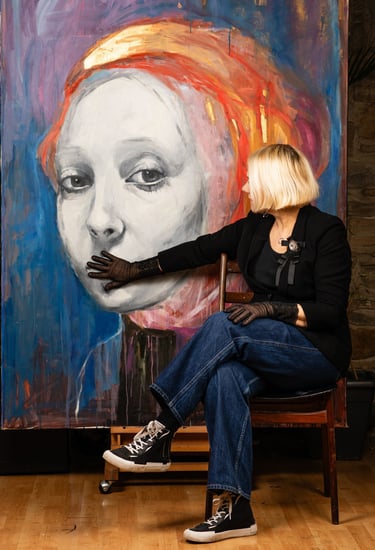
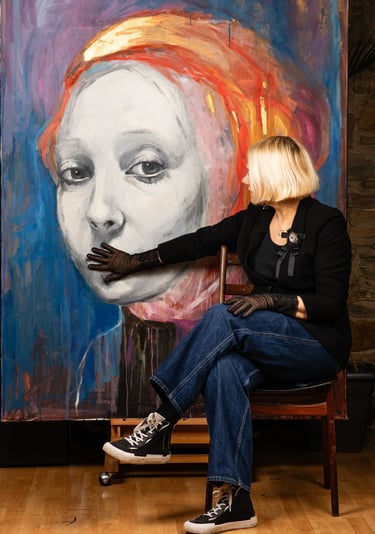
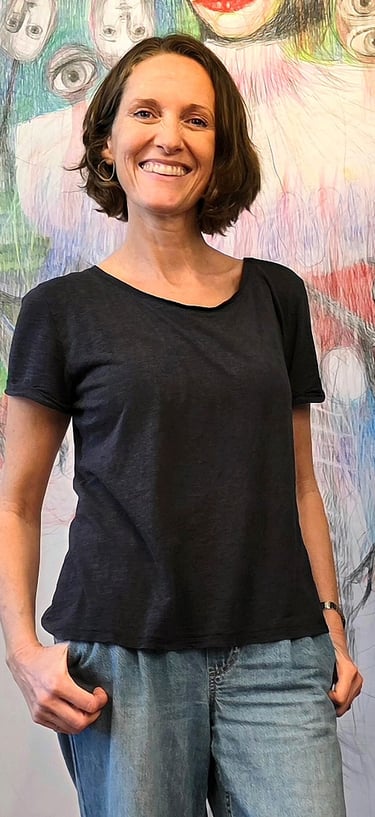
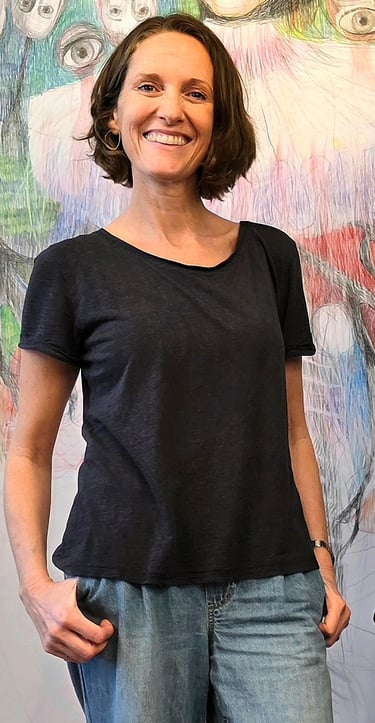
Conversation with Svetlana Arefiev in her studio in Caluire-et-Cuire, 2026
Svetlana kneels down to work on the lower part of a large sheet of paper pinned to the wall. At the center of the vividly colored composition stands a strange female figure: a pale face with the calm, wide eyes of a doll, oversized red lips, a hat trimmed with lit candles, a delicate ruff… Instead of a dress, one can make out a stylized spine from which nerves—or perhaps roots—emerge… It is poetic, slightly unsettling, and richly colored — welcome to the world of Svetlana Arefiev!
After studying fine arts, you became an art restorer. How did you come to paint your own works?
Little by little, the need to create for myself became essential. It wasn’t a plan at first, but something very natural. Today, it has become a necessity — a way of expressing myself.
Your works are mysterious, intimate, filled with faces and organic forms that intertwine… It feels almost dreamlike. Do you plan your compositions in advance?
No, everything begins quite intuitively, almost instinctively. I sometimes have an image or a feeling in mind, but it remains vague. Then, as I draw, the forms gradually appear, transform, and intertwine… What I may plan are the colors — I love colored pencils and their harmonies!
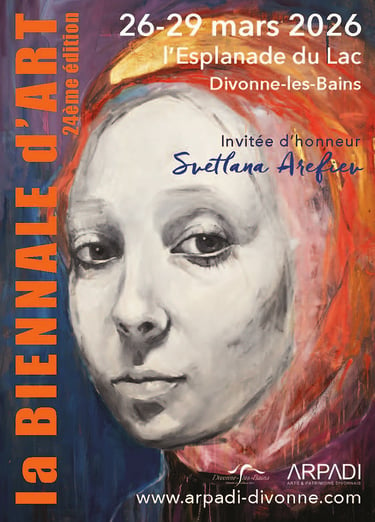
When you work on large paper scrolls, you must still have an overall idea of what you’re going to do, right?
It’s a very organic process. Faces, bodies, and shapes emerge like in a dream, without my trying to control everything. I let myself be guided by what appears.
She continues sketching quickly.
Do you ever go through phases of doubt?
Yes, but I think they are an integral part of the artistic process! During those moments, Irina reassures me and reminds me that it’s normal, that I have to accept it and keep moving forward. (Editor’s note: Irina is a cultural mediator of Svetlana). Large paper scrolls have become something of your signature, and you will present them at the Biennial.
How did you start working this way?
Quite intuitively, with the desire not to be limited by format. The scroll gives me a sense of freedom: I like telling endless stories that unfold without constraint. Large paper scrolls have become an ideal medium for this — they allow me to extend the gesture, to let images emerge and connect like a continuous narrative, without a real beginning or end. That said, I also work in smaller formats. It’s another way of expressing myself — perhaps more intimate, more concentrated. I enjoy moving between the two: not just for variety, but because each format takes me somewhere different, into a distinct rhythm and attention.
What would you like people to take away from your work?
I simply want to share happiness. I would like people to feel in harmony with themselves.
Do you think about your audience while working?
Oh no — when I work, I don’t think about others! (She laughs.) But afterward, if people come and look, I hope they keep a good memory of it, and that something opens within them. A small spark that triggers something.
Can you tell me about your sources of inspiration?
Well, I could tell you that inspiration comes when I take long walks in nature… But the truth is, I don’t know where it comes from! I just do it. “I do not wait for inspiration,” as Pablo Picasso said. I come to the studio every day at 2 p.m., have some tea, take my pencils, and start working. And then—it comes.
Why so many faces, and especially female faces?
People ask me that sometimes. And in fact, it’s often the audience’s questions that make me reflect on my own work! As for female faces—I don’t know, maybe simply because I am a woman. It’s easier for me to represent them and to convey my universe. There are also many dolls — perhaps for the same reason.
You paint many dolls, for example “Mathilde,” who appears in several of your works. Who is she, and why do you enjoy painting dolls?
Mathilde is a real doll from my collection! She inspires me a lot and appears naturally in several of my works. Dolls, in general, play an important role in my practice. They carry something ambiguous: both familiar and slightly unsettling, somewhere between childhood and strangeness. I like that tension! They almost become characters, with their own story and their own silence.
How do people react to your work?
It varies greatly! Some people feel a sense of softness or nostalgia, while others are a bit unsettled! The gaze in your portraits really draws the viewer into the work. It’s true — we first communicate through the gaze; words came later.
What does the Biennial theme “Intimate Cartographies” inspire in you?
“Intimate Cartographies” evokes an inner exploration — like drawing one’s own emotional landscapes. It’s very close to my work, where I try to bring out forms and faces that come from something deeply intimate, almost unconscious.
Text and photo: Ingrid Cox
Your works are mysterious, intimate, filled with faces and organic forms that intertwine… It feels almost dreamlike. Do you plan your compositions in advance?
No, everything begins quite intuitively, almost instinctively. I sometimes have an image or a feeling in mind, but it remains vague. Then, as I draw, the forms gradually appear, transform, and intertwine… What I may plan are the colors — I love colored pencils and their harmonies!
"Mauvaise Nouvelle": Interview with Svetlana Arefiev
Interview conducted by Maximilien Friche
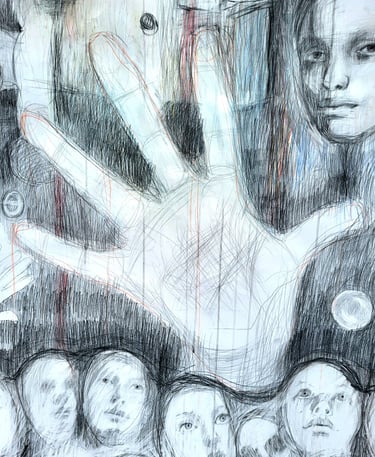
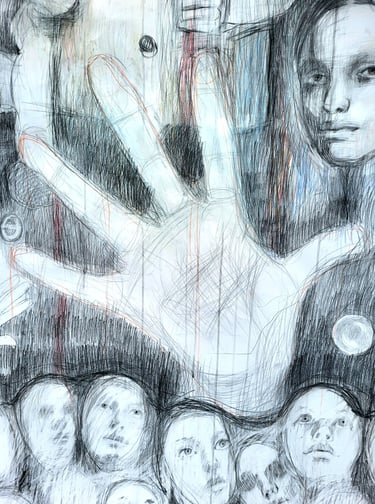
Svetlana Arefiev:
My painting is, above all, intuitive, and it’s difficult for me to put into words what I do—especially in French, which isn’t my native language. In fact, painting may very well be my true mother tongue—the one that allows me to express myself most naturally.
That said, I can tell you that my inspiration comes from the museums I’ve visited at length. Moreover, my former profession as a restorer forms a kind of foundation where my dreams and imagination take shape. Of course, I’m fascinated by the Renaissance, but also by the period that came before it, with its studies of the human body.
You see, for me, three elements must come together for Art to exist: a being who is the creator of the work; tools and technical knowledge; and something that cannot be controlled—soul. It’s a kind of alchemy that takes place.
I’ve chosen to paint faces, because to me, the face is where emotion is most deeply expressed. And with that emotion, I travel into another dimension—I travel through time. I imagine my character appearing in different situations and across various historical periods, sometimes far from our modern era. That’s how the faces of my models become transposed into my work.
To make a feeling and a face travel through time—that, perhaps, is the layer of modernity... You could say it’s an addition, but that feels too narrow. Modernity, to me, is like a key that opens the door to dreams.
June 14, 2020
Mauvaise Nouvelle: You say that your inspiration is both modern and classical. And indeed, when looking at all these faces emerging from your paintings, one thinks of the Renaissance. How does the layer of modernity operate? How is it expressed—by removing, by adding?
It is an exceptional moment—one is captivated by the emergence of beauty. And that precise instant, only the restorer is privileged to witness.
MN: You’ve worked as a painting restorer. Do you find that this former experience influences your current work? Are you searching for that magical moment in restoration when the painting begins to come alive again, when the colors revive? Is that moment of shift—and thus of balance—what you seek in painting? Would you say this is your own form of “sought incompletion,” as Nicolas de Staël might put it?
SA: Restoration work is purely technical, guided by the obsession with preservation. You add the bare minimum; you have to remain as discreet as possible. And when you remove the patina of time, there is a moment when the painting is revealed, uncovered, and the true colors burst forth.
That moment is exceptional—you’re captivated by the sudden emergence of beauty. And that moment, only the restorer sees. It’s a privilege I wanted to share when I began painting. That magical moment is what pushed me to become an artist.
Unlike restoration, painting is not driven by the pursuit of a result, but by the pursuit of a moment of emotion. My figures emerge gradually from the background, just like in the restoration process. While I work, I’m not seeking balance or a precise tipping point—because I’m not an architect. I simply follow my intuition to the end, until I reach the satisfaction of having revealed the emotion.
That impression of something finished-yet-unfinished comes from the fact that nothing is truly finished in nature; everything is in motion. The goal of the great alchemical work is to mirror the laws of nature, and imperfection is one of those laws.
MN: In your paintings, the face holds a central place. It seems to be the source of light. Is it where the light converges, or where it emanates from? When there are two faces, they seem to illuminate each other.
SA: The face—and especially the gaze—is the place of emotion, of feeling, of the senses, of dialogue with everything surrounding the person.
Let me share a little anecdote that may help explain this light that seems to come from the faces or is received by them. I spent my childhood in Moscow, Russia, and one of the rites of Soviet youth was visiting Lenin’s mausoleum. What struck me most was the memory of that long black hallway, and the sight of that body—real, lifeless—with its illuminated face. It was my first confrontation with death.
As a child, we believe ourselves immortal. Lenin was considered a god in the USSR. If Lenin was dead, then I, too, was mortal. It was traumatic. But I also remember the comforting light when I exited the mausoleum—the contrast of leaving that darkness behind and stepping into the glow of Red Square. I was bathed in light. My face received that light.
MN: In your series “Photographic Memory”, the disappearance of the face is never complete—there’s always a trace, an imprint in the light. There seems to be a cry for help, a call to be brought back. Is that the relationship of desire between you and the painting that you’re seeking to establish?
SA: The memory of the face that fades or reappears with the return of a memory, the floating image of a face—it’s perhaps an attempt, despite all the vanity it entails, to capture the essence of a person. It’s a gesture of reaching out, an evocation.
I must say, I love photography. I mean the kind that existed before the digital age. It was an alchemical, unpredictable process, dependent on the operator. Like in quantum physics, where the observer influences the outcome of the experiment.
I mostly paint faces from the past—people who are gone or who no longer look the way they once did. The features themselves don’t really matter anymore; it’s the memories and emotions they stir in those who view the photograph that count.
The unfinished nature of the Photographic Memory series—the unspoken—opens a door to the labyrinth we’re all in. New questions arise, and deeply personal answers emerge, sometimes far removed from what I imagined while creating the work.
MN: I’d like to speak about your relationship with time. In some of your paintings, the figures seem to be dressed in paint itself, playing with it. These faces appear to travel through time, shifting from one era to another, positioning themselves outside of time. Could your balance between classical and modern be seen as a harmony between the timeless and the current? What role does play have in your creative process?
SA: Like many women, I love costumes! I love imagining myself in different eras—past, present, future.
And to answer your question—that’s exactly what the element of play is in my paintings. It’s the child’s gaze I’ve kept. One should never take life too seriously.
That is the irony—where opposites meet. Once we have shed the weight of adult seriousness, we gain the lightness needed to rise toward the light.
MN: There is also irony in your paintings, expressed in different ways—a gravity that is just as present as a lightness layered over it. What are you trying to transcend? What universal message are you communicating? What is serious in your paintings? What is frivolous?
SA: As we’ve just said, I believe one shouldn’t take life too seriously. Anyone who is too serious ends up being ridiculous. That’s the irony—where opposites meet. Once we’ve shed the weight of adult seriousness, we gain the lightness needed to rise toward the light.
The universal message I share is very simple: nothing in this material world truly matters. Even the breath of life has no significance on its own. My paintings, as physical objects, have no importance either. The only thing that matters is the very personal feeling of the viewer, the emotion that draws them into the painting—it’s a doorway leading them toward their own paths of light.
MN: I’d like to end this conversation by returning to the faces. They are often grey, as if cut out and placed into an old found painting. One might say, childishly, that they haven’t been colored in. Why this choice? Why this rupture? Is there a kind of conflict in your paintings, and what does that conflict represent?
SA: Your last question brings us back to photography. The series of paintings made up of multiple cells, each showing the same face in different aspects, was inspired by photographic contact sheets—abandoned and discarded by a dissatisfied photographer. Sometimes, one of those grey faces deserved more attention and shouldn’t have remained anonymous among a row of failed attempts by its creator.
Its imperfection earned it a name, a character—its features, shaded in pencil, torn from the light of the film, began to tell a new story once painted on canvas.
So, no—there is no conflict in the harmony that exists even in the unfinished nature of my paintings. That unfinished state remains the guiding light of every Opus Magnum.
Contact us via our contact page or on social media
+33 664460079
info@artigora.com
© 2026. All rights reserved.